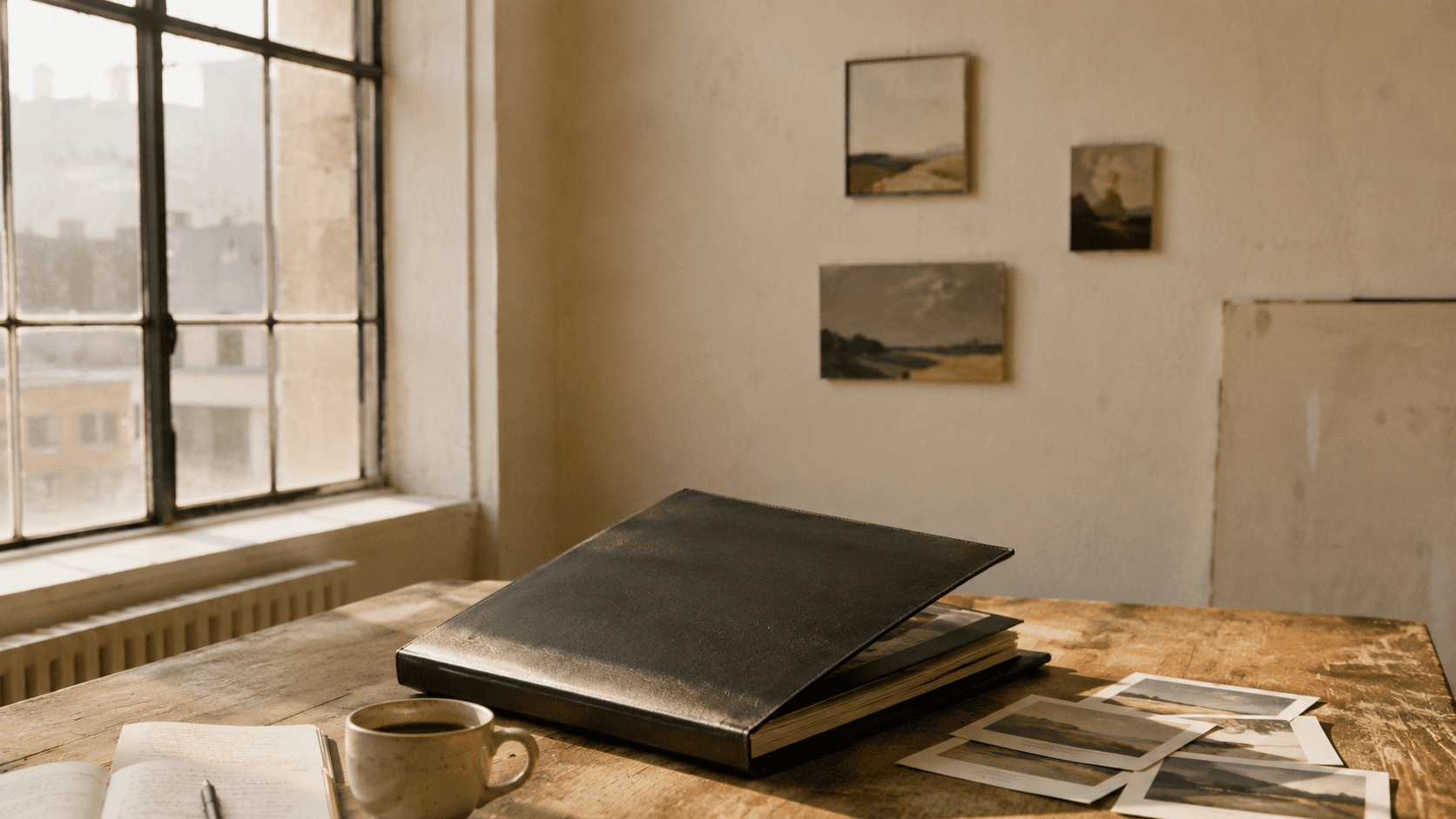
An art portfolio is a curated collection of your best work, presented in a way that shows collectors, galleries, and clients who you are as an artist. To create an art portfolio that actually sells, you need 10 to 15 strong pieces, professional documentation, a clear artist statement, and a platform that lets you share a single link with anyone.
This guide walks you through every step, from choosing what to include to picking the right platform. Whether you are applying to a gallery, building an online presence, or pitching your work to a buyer, the same six steps apply.
What is an art portfolio?
An art portfolio is a presentation of your art that tells a story about you as an artist. It is not a museum dump of everything you have ever made. It is a tight, intentional selection that says, in one glance, what you do and why someone should care.
Portfolios come in three main forms: a physical book or binder, a digital file like a PDF, and an online portfolio website. The online version is the one that gets shared, embedded on Instagram, and emailed to buyers, so most artists today need at least an online portfolio.
Why every artist needs a portfolio
An art portfolio is your sales surface. When a collector finds you on Instagram, the first thing they look for is a link. When you apply to a gallery, the curator wants to see how your work hangs together. When you negotiate a commission, the client wants proof you can deliver.
Without a portfolio you are starting every conversation from zero. With a portfolio you start the conversation already half-sold.
Step 1: Define your purpose and audience
Before you select a single piece, answer two questions:
- Who is this portfolio for? A gallery curator, a collector, an art school admissions panel, a private commission client?
- What do you want them to do after seeing it? Book a meeting, buy a piece, accept your application, share your work?
Each audience values different things. A gallery curator wants to see a cohesive body of work. A collector wants to feel a connection with you. An admissions panel wants growth and craft. Match the portfolio to the goal.
Step 2: Select your 10 to 15 best pieces
Most artists pad their portfolio with mediocre work to look prolific. Viewers judge you by your weakest visible piece as much as your strongest. Choose 10 to 15 pieces maximum.
Pick work that is:
- Recent. Within the last two to three years, ideally.
- Cohesive. A similar style, palette, subject matter, or theme.
- True to your voice. Not safe copies of trending styles, your own vision.
- Diverse enough. Show range within your style, not every style you can do.
If you only have five pieces you are truly proud of, show five. A short, strong portfolio beats a long, uneven one every time.
Step 3: Document your work professionally
This is where most portfolios fall apart. A great painting photographed poorly looks worse than a mediocre painting photographed well. Spend the time here.
For 2D work:
- Shoot in even, natural light, ideally on an overcast day near a window.
- Position the camera dead-centre, perpendicular to the surface, to avoid keystone distortion.
- Use a tripod so the image is sharp.
- Edit for true colour: white balance the background to neutral, then check the artwork colours against the original.
For 3D work, take three to five angles per piece, including a hero shot and a detail shot.
Every image needs a title, dimensions, year, and medium. Many artists also add a one-sentence description that gives context.
Step 4: Choose your portfolio platform
You have three options:
Physical portfolio
A printed book or binder. Still relevant for in-person interviews and gallery visits. Costs money and is hard to update.
Digital PDF
A self-contained file you email or upload. Easy to control. Bad for sharing on social media. Goes out of date the moment you finish it.
Online portfolio website
A dedicated site at a URL you can share. The default choice today. Works on phones, accessible anywhere, easy to update. Most platforms let you embed the portfolio on your Instagram bio or a personal site.
For most artists in 2026, the online portfolio is the primary version, with a PDF as a backup for formal applications.
Step 5: Write your artist statement
An artist statement is a short paragraph, usually 100 to 200 words, that explains the why behind your work. It is not a CV and not a press release. It is your voice.
A good artist statement covers:
- What you make (medium, subject, scale).
- Why you make it (the question or theme that pulls you in).
- What you want a viewer to feel or take away.
Avoid jargon. Read it aloud. If it sounds like a textbook, rewrite it until it sounds like you.
Step 6: Keep your portfolio updated
A portfolio is a living document. New pieces in, weaker pieces out, every three to six months. Always show your strongest current work, not your most prolific recent month.
Set a calendar reminder. Open the portfolio. Cut one piece. Add one piece. That single habit keeps your portfolio honest.
How many pieces should an art portfolio have?
Most curators and collectors prefer 10 to 15 pieces. For graduate school applications the range is often 15 to 20. For commission pitches, 5 to 10 highly relevant pieces beats a generic 30. Quality beats quantity at every level.
Common mistakes to avoid
- Showing everything. Padding kills perceived quality.
- Bad photography. Glare, off-colour, blurry, all break the spell instantly.
- No clear focus. Five paintings, three sculptures, a logo design and an architecture project all in one portfolio reads as confused, not versatile.
- Outdated work. Pieces from five years ago that no longer represent who you are.
- Missing details. No titles, no dimensions, no year, the viewer has to guess.
Build your art portfolio with 360Artwork
360Artwork is an art portfolio platform built for painters, illustrators, and photographers. Instead of a flat grid of thumbnails you get a walkable 3D gallery where every piece can be experienced at real size, in a real room.
You can build your first portfolio for free, no credit card, no commission. Upload your work, choose a 3D space, share a single link.
Start building your art portfolio in minutes, or see how the platform works first.